Is the Future of Marketing Automation AI? 

08/11/2026 02:14 PM - By Candice DeRiso

Marketing Automation

Using AI as a Strategic Co-Pilot, rather than a Replacement, for your Marketing Automation

Marketing automation goes beyond tools like Zoho's Marketing Automation and integrating Zia (Zoho's AI Assistant).  It is rooted in strategy frameworks that streamline customer interactions, personalize messaging, and optimize campaign performance. 


When we integrate artificial intelligence into our marketing strategy, then marketing automation can potentially become more intelligent and adaptive. AI enhances our automation systems by analyzing vast amounts of customer data in real time, enabling predictive analytics to anticipate user behavior, and delivering highly personalized content at scale. It can help you to adjust campaign timing, channel selection, and messaging based on individual preferences and engagement patterns. Those adjustments can lead to higher conversion rates and improved customer experiences. This synergy between marketing automation and AI can transform your workflows into responsive, self-learning systems that continuously evolve with market trends and customer needs.

What is Marketing Automation?

Before diving into using AI to generate all your marketing content and manage your campaigns, it's important to first understand what marketing automation actually is. 

Marketing automation leverages software and technologies to more efficiently handle, automate, and track repetitive marketing activities such as email campaigns, social media updates, lead scoring, and ad scheduling. The goal is to guide your prospects through personalized, timely experiences via customer journeys. These automations allow human marketers to concentrate on strategic planning and creative development.


Simply Said... Marketing Automation is when we use software to handle repetitive marketing tasks to free ourselves from tedious work so we can focus on planning and strategy.

AI is Reshaping Marketing Automation

Yes, moving from the idea of fixed rules to adaptive intelligence is exciting. However, shifting from classic marketing automation to AI-driven  automations requires your business to have a detailed marketing strategy in place. AI is only as intelligent as the information you feed it. 

Can you get AI to run your marketing campaigns for you? Sure, but you cannot depend on it to know how to properly set up the system that aligns with your business.  

AI can be used to enhance every stage of your marketing to sales pipeline. Some of the ways people are doing this: 

1. Generating Content

Generative AI can speed up content creation and testing by automatically producing tailored email subject lines, ad copy, and visuals. Though, it is crucial to maintain your brand's voice and have human oversight to review and refine the output. One major drawback is that many AI tools produce content that feels ... well, artificial. Before setting up your next email in Zoho Campaigns or Zoho Marketing Automation, you can use Zia to generate A/B test variations  of email content within Zoho Writer. Then you can visually present results in Zoho Analytics for easy review.


We suggest being careful of unstructured, dynamic content automatically generated by AI in emails. Instead, establish clear rules to manage its use. With your content goal in mind, use AI as a content suggestion aid. Then a person should review every email and approval it before sending. It will speed up the content process but also help your organization steer clear of embarrassing "AI copy" that isn't your own (or factually correct). 

CRM TIP

Use Zia Scores in Zoho CRM to dynamically update scoring rules based on recent interactions. 

2. Optimal Segment, Time and Channel

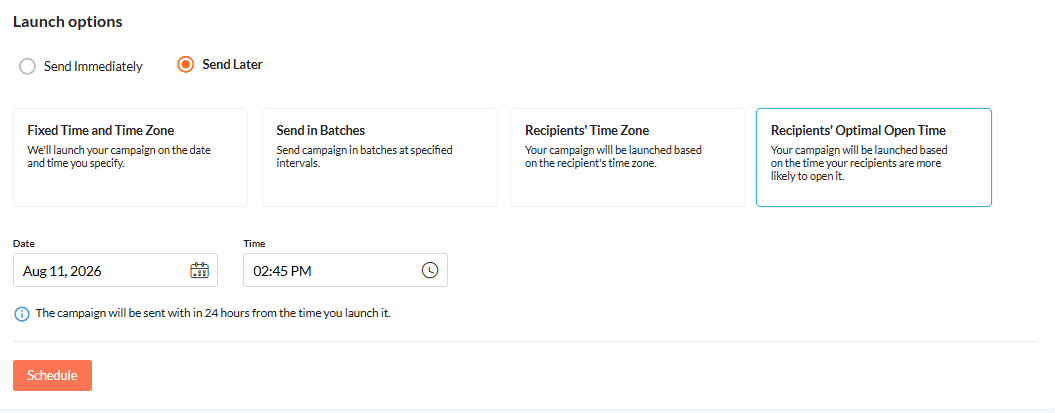
Traditional automation delivers identical email campaigns and SMS messages to predefined customer segments. Whereas AI can be used to analyze real-time data such as email interactions and previous purchases, then update those segments and personalize the content. It can identify optimized sending times for each contact in your marketing campaigns. 

Campaigns & Marketing Automation TIP

Both Zoho Campaigns and Zoho Marketing Automation will recommend optimal send times for different audience segments using historical engagement data from campaigns.
3. Help with Lead Qualification

Machine learning can analyze past customer and prospect behavior to identify the most promising leads for sales outreach. This is more dynamic than scoring rules. However, you can use your static scoring rules to train the system (and your sales team) on what fields and activities are indicators for successful sales. 

Over time, the model learns from real-time interactions, such as website visits, email open rates, and demo requests, to continuously refine its predictions. This adaptive approach allows sales teams to respond more effectively to changing customer behaviors and market conditions.

Using Zia within Zoho CRM can enhance traditional lead scoring by combining behavioral data with predictive analytics. Train Zia on historical lead conversion data to predict which leads are most likely to convert, using fields like website visits, demo requests, and content downloads. 

"Zia scores your records as a percentage, calculated using win behavior, the related sales activities, the responsiveness of the lead or prospect, and the time invested. Beyond those four core signals, Zia also draws from leads, deals, activities, communication history, and any custom modules or fields your team has built." (Source: Zoho)

 Syncing this smart data with Zoho Marketing Automation can be used to trigger personalized nurture sequences.  Combine Zia’s predictions with static rules (e.g., "if a lead has visited the pricing page 3 times, assign 20 points") to create a hybrid scoring model that’s both rule-based and adaptive.

4. Identify High-Value Customers

With enough data in your CRM system, AI can detect high-value customers who are at risk of leaving. This is a powerful tool that can enable proactive client retention strategies. Just like your prospects, you can leverage scoring rules to know the indicators.

The effectiveness of this functionality relies heavily on clean, accurate data which makes data hygiene essential. Zia in Zoho Analytics is one tool that can offer in-depth insights into customer behavior and even predict future actions.


Leverage Zia to identify customer behavior trends from the data you track, such as decreased login activity or missed renewal dates. Then you can use time-series forecasting to predict churn risk. 

Set up automated alerts for high-risk customers, triggering proactive retention efforts through either Zoho CRM automations or Zoho Marketing Automation Journeys. In addition, you can visualize churn forecasts in Zoho Analytics with AI-driven insights, empowering marketing and sales teams to take action before customers depart.

Using a Unified System: Zoho Apps

Zoho apps integrate with each other as well as third party apps (such as social media). This means that your marketing automation flow can ... flow smoothly. 


Imagine that a customer engages with an email in Zoho Marketing Automation where you identified it as a purchase indicator, Zia tracks that behavior, then updates their Lead record in Zoho CRM. This is followed by a personalized follow-up in either Zoho CRM or Zoho Automation is triggered. This end-to-end automation captures, evaluates, and responds to each interaction in real time. The manual data entry is eliminated, but the human oversight is still in place to ensure the business' brand is aligned.

A Few Best Practices for Fellow Zoho Users

  1. Always validate AI-generated content. Whether you're using AI through at outside LLM such as ChatGPT or Zoho's Zia, include the human touch. And when possible, try using some of Zoho’s built-in approval workflows to maintain brand tone and compliance. 
  2. Maintain clean, consistent data. Good data in Zoho CRM means you'll have good data for reporting in Zoho Analytics and it ensures the accuracy of Zia’s predictions. If you need support with data integrity and quality maintenance, ask for some help. 
  3. Start small: Begin by testing AI-driven content suggestions or lead scoring in a single segment or campaign to assess effectiveness before scaling.

GET HANDS-ON SUPPORT

We're hosting a webinar and an in-person working session to support our community with Marketing Automation. 

Click the buttons below to learn more